1
4:52 p.m. The 30th.
The bank's message arrived with the punctuality of an executioner.
Your salary has been deposited.
Valentina Ríos read it three times, standing next to the agency printer with a cup of coffee still steaming in her other hand. Three times, as if the third would change the number.
It didn't.
It was a round, clean, almost beautiful figure. For exactly eight minutes, it was hers.
At 5:00 p.m. the hunt began.
The rent, due on the first. The credit card payment, already two days late and quietly piling up interest like a leak in the wall. The phone plan. The music subscription she shared with Camila and that Camila never paid back. Half the utilities, because Tomás "was still studying." Groceries. The sofa installment: twelve interest-free payments that, as she discovered too late, did have interest. Transportation. Lunches.
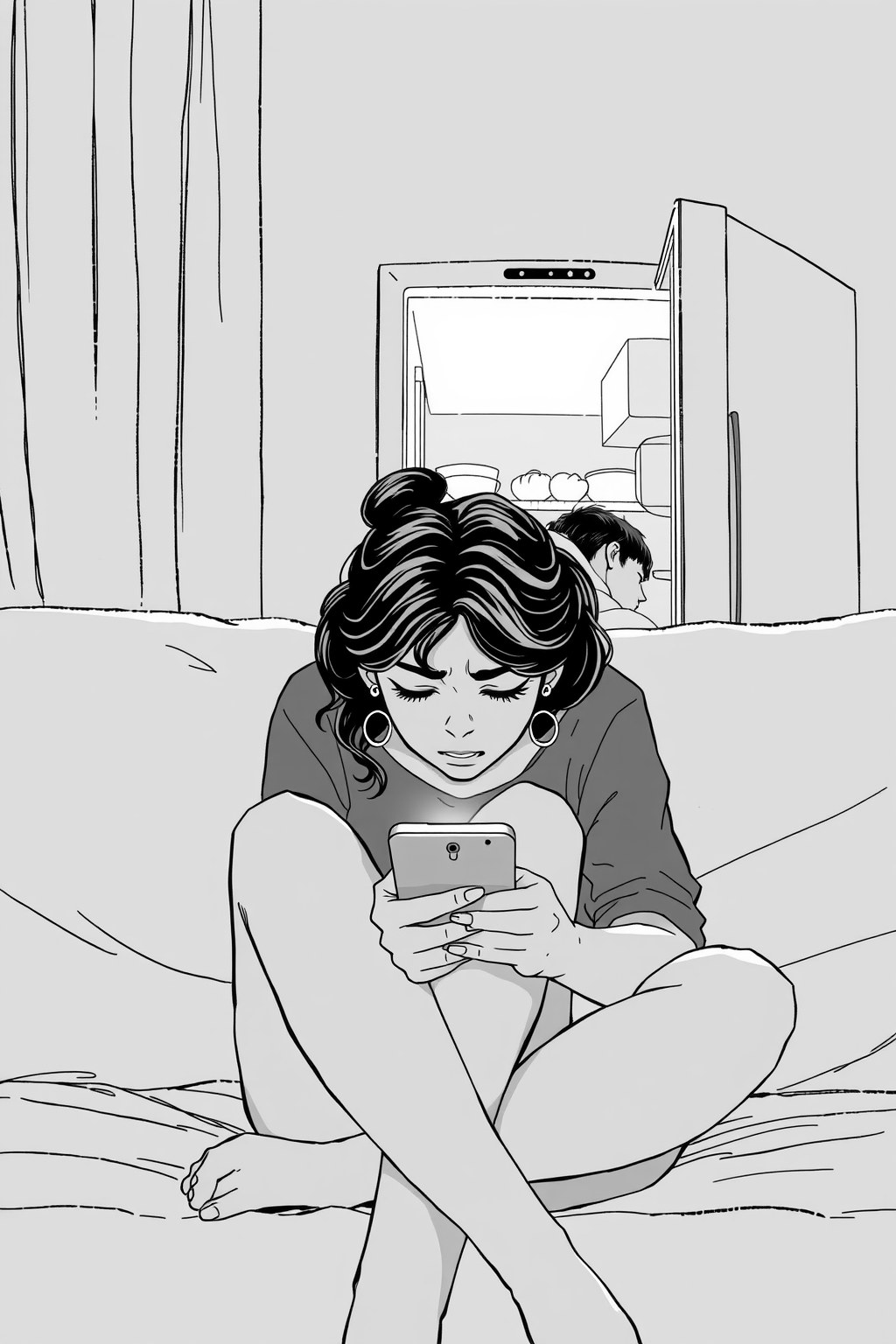
At 9:14 p.m., sitting on that same sofa, Vale opened the app one last time.
Twenty-eight dollars left.
And thirty days until the next paycheck.
2
It wasn't a tragedy. Nobody was going to die over twenty-eight dollars.
But there was something in that number that produced a very precise mix of shame and anger, as if someone had robbed her and she had left the door open. She was twenty-seven. She was a graphic designer at an agency that paid her on time and considerably better than most of her friends. She worked nine or ten hours a day.
And the balance of all that effort fit into a single number.
"What are you doing?" Tomás asked from the kitchen, his head inside the refrigerator.
"Counting what I don't have."
"Oh. That. I stopped doing that a while ago. Better for your mental health."
Tomás was twenty, studied engineering, and held the theory that money was a problem you solved by earning more, never by spending less. His concrete plan for earning more changed every week.
Vale closed the app and stared at the ceiling.
If I earn well, why do I have nothing?
She didn't know the answer was half a block from her house, in a shop that smelled of oil, in the hands of an old man who had been hiding something for twenty years.
3
Saturday. 12:40 p.m.
The routine hadn't changed in years: bring Don Aurelio his lunch.
The bicycle shop had occupied the corner since before Vale was born. A small, dim place, with dozens of bicycles hanging from the ceiling like colored bats. Gloria, Vale's mother, sent lunch every Saturday because, according to her, "that man doesn't eat well, and he fixed your father's bicycle for free when we couldn't pay."
That had happened twenty years ago. Gloria didn't forget favors.
"Afternoon, Don Aurelio."
"Afternoon, mija. Put it there on the table, my hands are a mess."
The old man was adjusting the spokes of a wheel with a tiny wrench. He'd spin the wheel, listen, tighten a quarter turn, spin again. He had a patience from another planet. And he had, Vale noticed for the first time, a drawer in the workbench closed with a padlock.
She had never seen a padlock in that shop.
"What's with the face?" he said, without looking up.
"What face?"
"The face of someone who just saw their bank balance."
Vale laughed, surprised.
"That obvious?"
"It's the most common face in the world. I see it every 30th. And every 15th, too."
4
She sat on a small wooden stool, the same one she used to sit on as a girl when she came with her father.
"I don't get it, Don Aurelio. I earn well. Compared to a lot of people, I earn well. And I have nothing left. It's like money comes in through one door and goes out through another, and I'm just standing in the middle watching it pass."
Don Aurelio spun the wheel once more. This time it made no sound. He lifted it off the stand carefully, like someone lifting a sleeping child.
"And who did you pay this month?"
"What do you mean?"
"Who did you pay. Tell me."
Vale listed them: the landlord, the bank, the phone company, the music company, the utilities, the furniture store, the transit company, the restaurants.
"And you?"
"Me what?"
"How much did you pay yourself?"
Vale opened her mouth to answer.
And discovered she had no answer.
"I… didn't pay myself anything. What was left was left. Twenty-eight dollars."
"Ah," said Don Aurelio, without drama, like someone noting that it's raining. "So you worked the whole month for all of them. And you got the leftovers."
5
The sentence hit her like a bucket of cold water.
You worked the whole month for all of them. And you got the leftovers.
"But you have to pay for things, Don Aurelio. It's not like you can skip the rent."
"Of course you have to pay. Nobody says you don't."
The old man wiped his hands on a rag that cleaned nothing. He looked at the padlocked drawer. He hesitated for a second, barely perceptible. Then he sat on the other stool.
"I'm going to tell you something someone told me when I was about your age. It changed my life. Literally. No exaggeration.
"I worked in a shop that wasn't mine. The owner was an old man, older than I am now. One day he saw me with the same face you have. He asked me the same thing I asked you. I answered the same thing you answered. And he said: 'Aurelio, of every ten coins you earn, one is yours. It's not for the rent, it's not for food, it's not for anyone. It's yours. And you're going to put it away before you pay anyone else. Before. Not after.'"
"Before the rent?"
"Before everything. That's the trick. If you wait to see what's left, nothing is ever left. You proved it this month. The money that remains at the end is the money nobody claimed, and somebody always claims it. But if you take it out first, the rest arranges itself. I don't know how. But it does. People live on ninety percent without noticing that the ten is missing."
Vale did the math in her head. Ten percent of her salary seemed, at the same time, a small figure and an impossible one.
"And what do I do with that coin?"
"At first, nothing. Keep it. What matters isn't the coin. It's the habit. Teaching your hand to set aside before it hands out. Later we'll talk about what to do with it. But if you don't set it aside, there's nothing to talk about."
"And you did it?"
Don Aurelio stood, hung the wheel in its place and pointed at the shop with his chin.
"You think I bought this with the leftovers?"
Vale looked at the shop. The walls. The bicycles. The padlocked drawer.
And for the first time she wondered what else that man had bought with the coin he set aside first.
6
10:47 p.m.
That night Vale opened the bank app, but not to look at the balance.
She found the option to create a separate savings account. The system gave it a default name: "Savings 2." She erased it.
She typed: Mine.
Then she did something that felt ridiculous and brave at once: she scheduled an automatic transfer of ten percent of her salary for the 30th, at 5:00 p.m. Eight minutes after payday. Before she'd have time to think about it.
She looked at the twenty-eight dollars she had left. She sighed. She moved ten dollars to "Mine."
It was almost nothing. But for the first time in her life, a part of the money she earned had her name on it before anyone else's.
"What are you doing?" Tomás asked from the sofa, without looking up from his phone.
"Paying myself."
"Paying yourself what?"
"Me. First."
Tomás lifted his head, looked at her as if she had spoken another language, and went back to his phone. After a while, in a tone that tried to sound casual:
"And where'd you get that from?"
"From Don Aurelio."
"The bike guy? What does that old man know about money?"
Vale didn't answer. She thought about the padlock.
She still didn't know how much Don Aurelio knew. But she was beginning to suspect it was a good deal more than the two of them put together.
And that the locked drawer had something to do with it.
What Vale Learned
A part of everything you earn is yours to keep. If you wait to see what's left at the end of the month, nothing will be left, because someone will always be claiming that money. The rule is simple and brutal: pay yourself first, before anyone, and learn to live on the rest. At the beginning the amount matters less than the habit; what you are training is the hand that sets aside before it hands out.
Where This Lesson Comes From
From The Richest Man in Babylon, by George S. Clason (1926), a classic that teaches finance through parables set in ancient Babylon. Its first and most famous rule, spoken by the character Arkad, is exactly this: "a part of all you earn is yours to keep." Almost a century later, it remains the starting point of any healthy financial life.
Do This Today
Open a separate savings account, give it a name that means something to you, and schedule an automatic transfer of 10% of your income for the same day you get paid. If 10% seems impossible, start with 5%. What matters is that it's automatic and that it happens before you spend a single dollar.